

IPG Talks: Iptek, Riset, dan Inovasi dalam UU Cipta Kerja
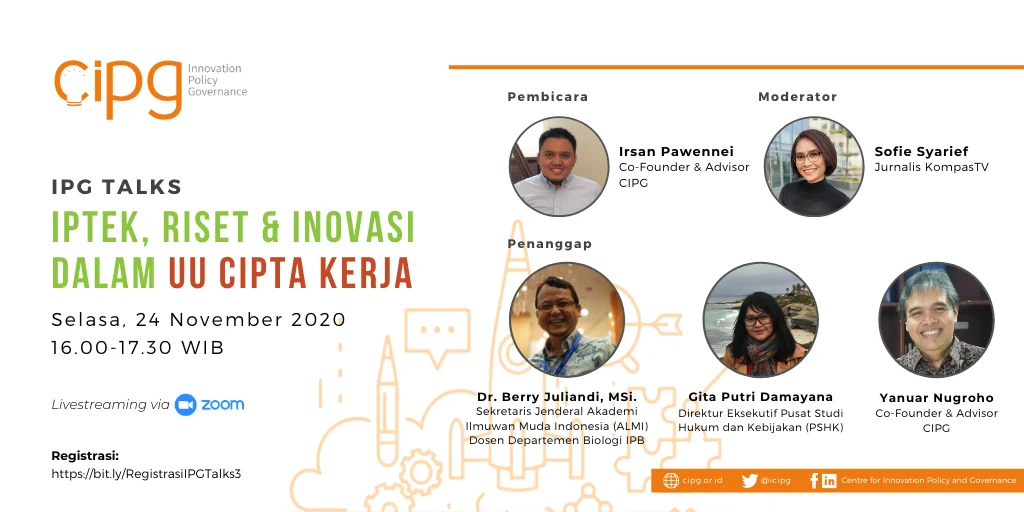
Undang-Undang (UU) Cipta Kerja atau Omnibus Law Cipta Kerja telah resmi disahkan pemerintah. Salah satu klaster yang terdapat dalam UU Cipta Kerja menyentuh perihal iptek, riset, dan inovasi. Telaah menyeluruh terhadap dampak UU Cipta Kerja pada iptek, riset, dan inovasi perlu dilakukan untuk memberikan gambaran dan menjadi basis pertukaran wawasan dalam upaya pengembangan ekosistem pengetahuan […]
Mengobarkan Inovasi, Mengorbankan Standar Mutu: Telaah Isu Iptek, Riset, dan Inovasi dalam UU Cipta Kerja
One important element supporting innovation and its implementation is the regulatory framework. The enactment of Law No. 11 of 2020 on Job Creation (Job Creation Law) has likewise had implications for innovation in Indonesia. Within the Job Creation Law, aspects of science and technology, research, and innovation are addressed in 29 articles across 10 chapters. […]
Iptek, Riset, dan Inovasi dalam UU Cipta Kerja
The Job Creation Law, also known as the Omnibus Law on Job Creation, was officially enacted by the Indonesian government. One of the clusters covered by the law concerns science and technology, research, and innovation. A comprehensive review of the law’s implications for these areas is needed to provide an overview and serve as a […]
Doing Research in Indonesia
Abstract is taken from this page of Global Development Network Recent research on the organization of research production in Asia shows the effect of marketization on the quality of academic work. The Indonesian case provides a complex picture of these effects in a post-authoritarian context. Market-driven research production is not independent or of high quality […]
Strengthening the Bridge towards Inclusive Policymaking: A Collective Learning with Six Civil Society Organisations
This synthesis report titled “Strengthening the Bridge towards Inclusive Policymaking: A Collective Learning with Six Civil Society Organisations” came as a form of public accountability for the CIPG programme called “Echoing Evidence: Using Action Research for Inclusive Participation”. This report contains learning analyses by CIPG while undertaking the aforementioned programme between August 2017 until August […]
Menggaungkan Suara Marginal: Cerita dari Kawasan Timur Indonesia
Public policymaking should ideally be conducted in an integrated and comprehensive manner, taking into account all relevant factors. Public participation is an essential prerequisite for ensuring that the process is inclusive. Therefore, evidence-based public policymaking, particularly in local contexts, should be promoted by placing local knowledge and the perspectives of local actors at the forefront. […]
Inovasi dan Hidup Bersama Kita
Times are changing rapidly. At least over the past five years, we have witnessed innovation emerging in many different forms. Many of these innovations have helped people live better lives. Online transportation services, for example, have helped many people navigate the capital’s traffic more efficiently. However, we must also acknowledge that innovation can have unintended […]
Innovation Outlook: Refleksi Inovasi Berbasis TIK di Indonesia
Indonesia is currently undergoing a transformation toward a digitally oriented society. This shift is driven by the rapid and significant development of Information and Communication Technology (ICT), which has advanced far more quickly than previously anticipated. ICT has played a major role as a catalyst for innovation and has reshaped the landscape across various sectors. […]
Innovation Outlook: Memetakan Potensi dan Tantangan Ekonomi Digital di Indonesia

Indonesia kini telah berada dalam masa transisi menuju era digital. Hal ini terlihat dari studi oleh We Are Social (2017) yang menyebutkan bahwa 51 persen masyarakat Indonesia telah memiliki akses ke internet, walaupun masih berpusat di pulau Jawa. Selain itu, penetrasi smartphone telah mencapai 47 persen dengan penggunaannya berkisar antara media sosial, hiburan, dan berita. […]
Terjun dalam Kebijakan Publik

“Pada kehidupan sehari-hari, kita membentuk ide tentang orang lain dan tentang situasi sosial. Kita menginterpretasikan perilaku orang lain dan memprediksikan apa yang akan mereka lakukan apabila menghadapi sebuah situasi tertentu.” -Fritz Heider (1958), Psikolog Mempelajari psikologi berarti berusaha merasai ‘sepatu’ orang lain, menjadi diri yang penuh empati. Setidaknya itulah esensi dari empat tahun studi saya […]